The RMJM Global Ecosystem
Transforming a legacy corporate footprint into a scalable lead platform.
Digital infrastructure built for global scale.
- The Disconnect: A massive architectural firm with zero digital cohesion and an interface that failed to convey its true international prestige.
- The Objective: Unify eleven independent global studio operations into a centralized, modern web infrastructure.
Deconstructing elite industry competitors.
- The Benchmark: Audited tier-one design practices (OMA, Snøhetta) to map modern architectural communication strategies.
- The Discovery: Top practices abandon standard grid galleries, relying instead on editorial storytelling to capture prospective buyers.
Exposing broken corporate pipelines.
- The Broken Funnel: Flagged critical usability bottlenecks, including a global contact structure that misrouted localized leads.
- The Core Issue: Project templates treated high-value case studies as static photo albums rather than active business development assets.
Structural mapping from lead to localized studio.
- The Operational Loop: Created an end-to-end service schematic aligning user navigation paths with localized studio business processes.
- The Inversion: Eliminated central gatekeepers, routing high-intent project opportunities directly to regional directors.
Translating legacy data into functional layout rules.
- The Traffic Baseline: Discovered that 70% of inbound web traffic arrives deep within individual project pages via search engines.
- The Realization: The traditional homepage is a vanity asset; the project layout node is the actual entry point of the site.
“We win work studio by studio. The site wins it for no one.”
— Principal, Dubai
“Every brief comes through Edinburgh and gets re-routed by hand.”
— BD Lead, Global
“I had to ask which office to talk to. Not a great first impression.”
— Hospitality Developer, GCC
Exposing back-of-house workflow friction.
- The Hidden Bottleneck: Discovered business development teams spent hours manually rebuilding layouts into custom proposal PDFs.
- The System Response: Engineered the digital framework to automate case study generation, eliminating manual double-work.
Inbound from contact form. No sector tag. BD lead spends 8 min identifying it's a hospitality brief in Riyadh. Forwards to KSA principal.
Builds pitch deck. Cannot find rendered exterior for The Address Tower in shared drive. Screenshots the live project page.
Calls Milan to confirm a hotel reference is theirs. It is. Site shows no studio attribution on that project.
- — Personal Dropbox of "good renders"
- — WhatsApp group titled "RMJM assets pls"
- — Hand-tagged Notion of who-led-what
- — PDF of every press hit, manually maintained
Aligning independent regional directors.
- The Alignment Session: Facilitated cross-studio alignment workshops to establish an editorial design framework.
- The Result: Replaced internal territorial disputes with a unified commitment to a clean, shared global component library.
HMW route inquiries to the right studio in one click?
HMW make every project legibly attributable?
HMW surface sector expertise on the homepage?
HMW give each studio a meaningful local voice?
HMW make press density visible to RFP committees?
HMW reuse renders as first-class brand assets?
Mapping user pain points to technical layout needs.
- The Blueprint: Translated qualitative insights into high-priority functional development targets.
- The Focus: Prioritized an inline regional studio switcher over unnecessary interface features.
| # | Opportunity | Theme | Impact | Effort |
|---|---|---|---|---|
| O-01 | Route inquiries by sector + region | Routing | H | L |
| O-02 | Attribute every project to its studio | Attribution | H | L |
| O-03 | Sector-led homepage | IA | H | M |
| O-04 | Studio pages with local BD contact | Studios | H | L |
| O-05 | Faceted project archive | Discovery | H | M |
| O-06 | Render library as first-class asset | Assets | M | L |
| O-07 | Press density on project pages | Trust | M | L |
| O-08 | RFP-ready PDF export per project | Conversion | H | M |
| O-09 | Careers funnel per studio | Talent | M | M |
| O-10 | Editorial 'Notes from the Studio' | Voice | M | H |
The project page as the keystone narrative asset.
- The Paradigm Shift: Restructured individual project templates to read like an immersive, high-end editorial monograph.
- The Layout Rhythm: Introduced a dynamic vertical layout pairing massive imagery with bold serif headlines.
Proving the layout concepts with hard performance metrics.
- The Quantitative Leap: Task success rates surged from a baseline of 22% up to 89% on the new prototype framework.
- The Speed Surge: Average user time required to submit a regional project inquiry dropped from 6 minutes down to 51 seconds.
Guiding intent cleanly down to localized humans.
- The 92% Core: Modeled four high-intent pathways covering the vast majority of standard web user activity.
- The Endpoint Strategy: Every pathway systematically terminates at a localized contact point, bypassing central triages.
Locking structural density prior to aesthetic styling.
- The Grayscale Grid: Built responsive structural grids across 1440px, 768px, and 375px breakpoints.
- The Validation Medium: Moved early layouts into browser testing to check real scrolling rhythm and type scaling.
Translating structural weight into digital layouts.
- The Palette Choice: Applied a palette of paper, ink, and a single terracotta tone referencing building materials.
- The Modular Framework: Structured the layout into six flexible component blocks that regional teams can easily arrange.
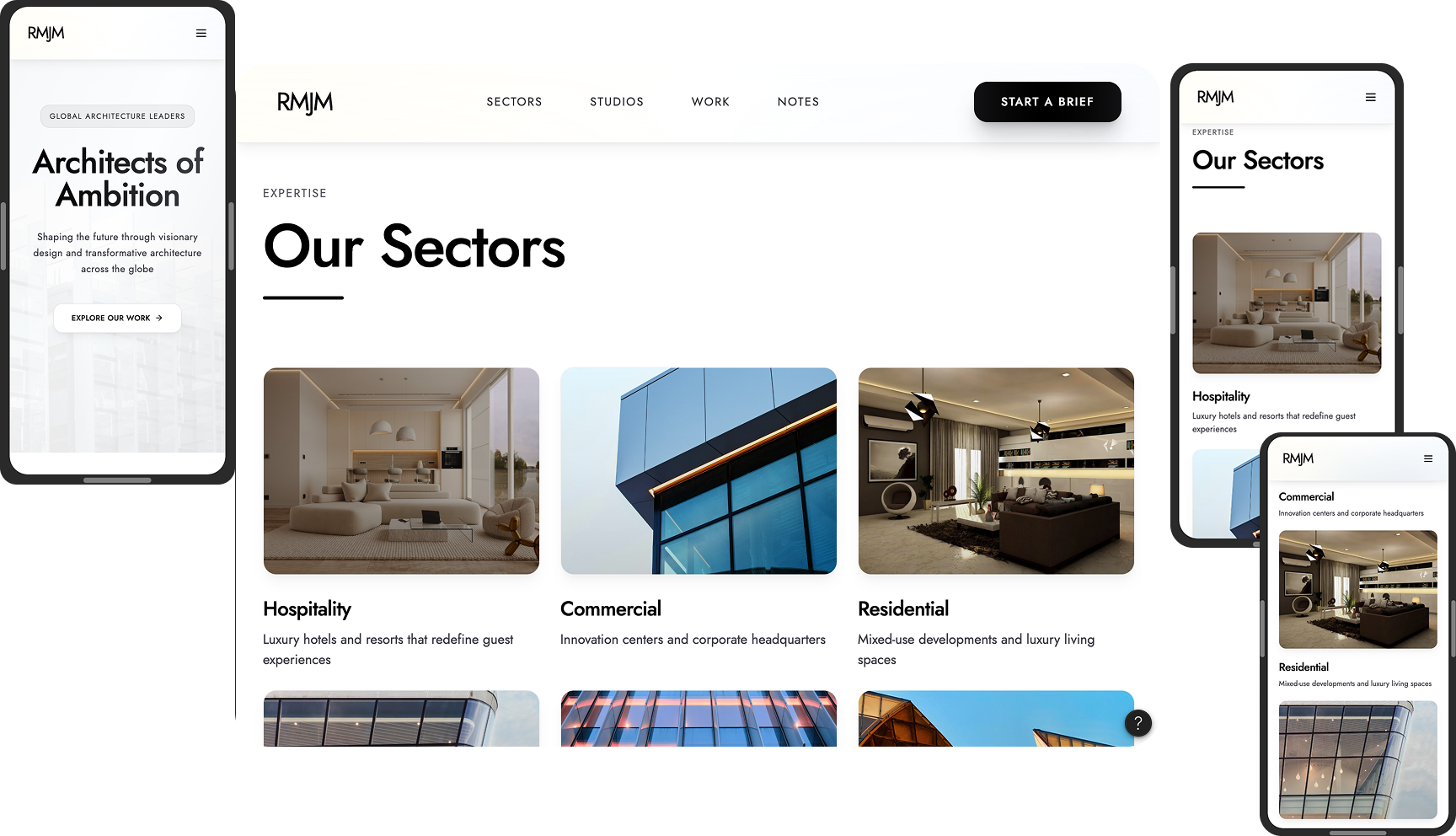
“Atrium” — a shared digital infrastructure.
- The Infrastructure Core: Built a component library on an 8-point spatial grid using primitive and semantic style rules.
- The Organizational Success: Achieved the first shared visual framework mutually adopted by all eleven international studios.